2022-2024
Designing for real emotions, not performed ones
A consumer-facing student app bringing Social Emotional Learning to Gen Alpha
Consumer App · Edtech · Human-AI Interaction · SEL
Lead Product Designer (Founding Role)
Context
If students don't engage, nothing else works.
Palo is a Social Emotional Learning platform for U.S. middle schools. It serves three types of users simultaneously: students, teachers, and school counselors.
The student app is the primary touchpoint. Counselors get their behavioral data from it. Teachers rely on it to run sessions without preparation. Schools renew their licenses based on whether students actually use it.
So the design challenge was clear from day one: build something a 12-year-old will willingly engage with, inside a normal classroom period, on a shared Chromebook, for a subject that isn't graded and that they didn't choose.
Every design decision in this case study lives inside that constraint.
Research & Contraints
Three users. One session. Very different needs.
Before designing anything, we spent 30 days in research - interviews, surveys, and deep collaboration with behavioral psychologists, child counselors, SEL researchers, and curriculum designers.
We were designing for three user types simultaneously, and each had conflicting needs.
- Students needed something engaging, interactive, and short.
- Teachers needed zero preparation and zero training.
- Counselors needed honest emotional data they could act on quickly.
Getting all three right in a single 8-minute session was the core design problem.
Gen Alpha are digital natives
Short attention spans, high expectations for interactivity, and immediate comparison to games and social apps. Lectures and videos were a hard no.
Gender neutrality is non-negotiable
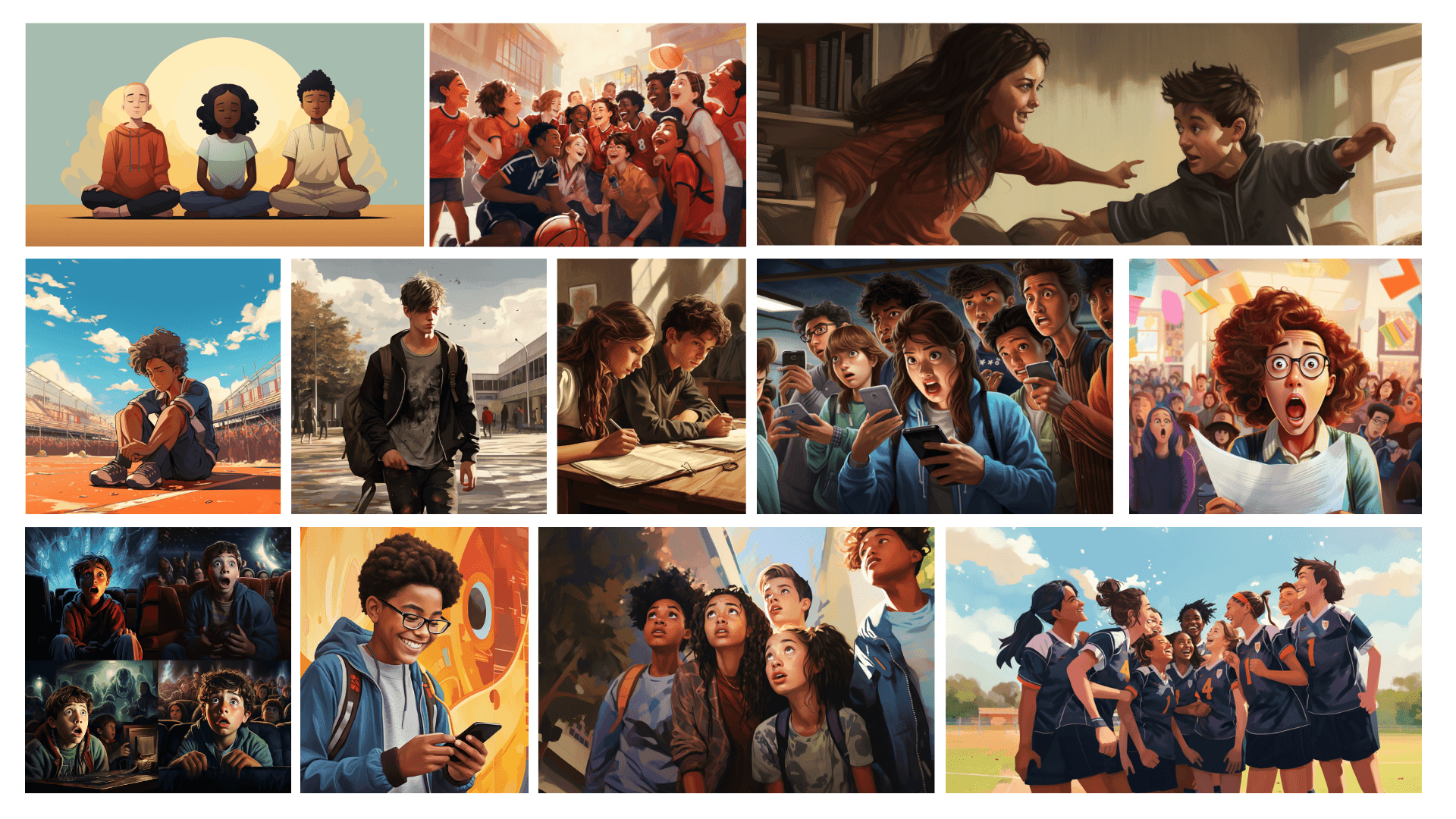
Students, schools, and parents all required that UI, content, visuals, and UX copy reflect gender neutrality, diversity, and respect for pronouns. This shaped every visual decision.
8 minutes is the real constraint
Sessions were designed to fit inside a normal subject classroom period without displacing academic time. Any teacher could run one with no prep or training. 8 minutes maximum.
Design Concept
Bite-sized, not lecture-sized.
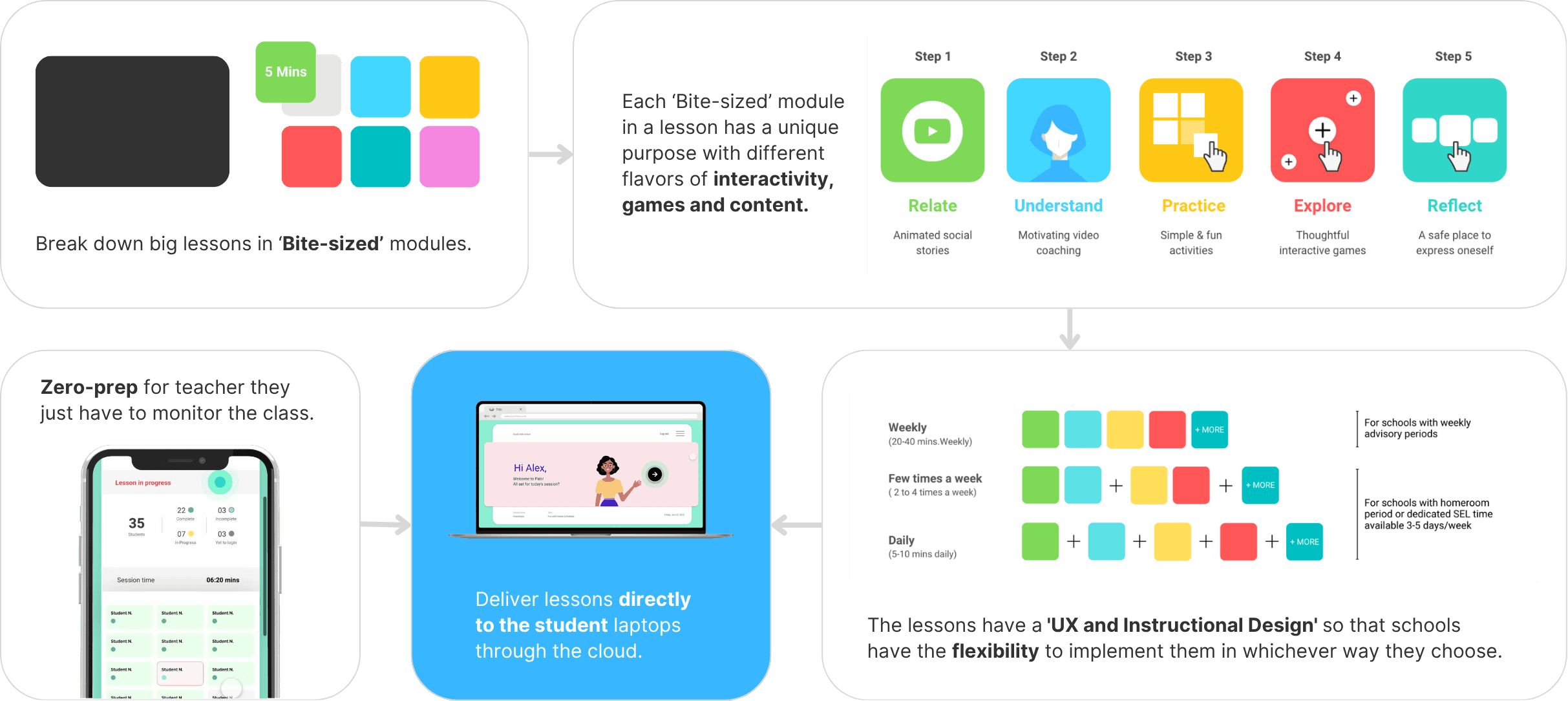
The central design idea was to break SEL lessons into small, self-contained modules - each with a different flavor of interactivity, content, or reflection. We called them bite-sized modules.
Each module had a unique purpose:
Step 1 - Relate: Animated social stories to open the topic
Step 2 - Understand: Short motivating video coaching
Step 3 - Practice: Simple, fun interactive activities
Step 4 - Explore: Thoughtful games
Step 5 - Reflect: A safe space to express oneself
Schools could configure the module combinations and delivery frequency - daily (5-10 min), a few times a week (20-40 min), or weekly. The same core system worked across all formats.
GenAI generated the intro and outro copy, contextualised to each module combination and delivery frequency. This kept sessions feeling coherent even when schools mixed and matched.
Constraint: Performance as a design problem
The school internet problem nobody talks about.
During our 3-month trial run with three schools, something kept breaking the experience: the internet.
School networks are slow. Chromebooks are shared and often older. Students were dropping out of sessions mid-way because videos buffered, interactive Lottie animations failed to load, and some activity elements timed out before they rendered.
We had designed for ideal conditions. Schools don't have ideal conditions.
So we went back and redesigned for reality.
Videos were recompressed for low bandwidth. Some heavy Lottie animations were replaced with lighter CSS-based transitions or simplified frame sequences. Interactive elements were rebuilt to degrade gracefully - if something couldn't load, the session continued rather than breaking.
| A broken experience in a classroom is worse than a simple one. Reliability over richness, every time.
The 'Mood Checker' : The feeling thermometer
When psychology told us to make it less expressive.
At the start of every session, students checked in on how they were feeling. This mood data fed directly into the counselor dashboard. It was arguably the most important interaction in the entire product.
Our first version was expressive. Animated emojis. Colourful illustrated faces. A playful interface that felt right for middle schoolers.
Then our psychologist team pushed back.
Their argument was simple: emojis are social signals. When a child sees a grinning face or a crying face, they don't report how they feel. They report what looks most appropriate, most cool, or what their friends nearby might think of.
The expressiveness of the UI was actively getting in the way of honest self-reporting.
| They recommended something that felt counterintuitive at first: a flat, faceless, colour-coded temperature scale. Like a fever thermometer.
The reasoning clicked once I sat with it. Kids already understand the thermometer as a tool for measuring discomfort. When you have a fever, the temperature goes up and you feel bad. Sliding the scale up means things feel worse. It's a metaphor they carry from childhood without any social performance attached to it.
We stripped out everything expressive. No faces. No emojis. Just a smooth gradient scale, sliding from cool to warm, with a simple prompt: how are you feeling right now?
Counselors could then read the data knowing it reflected genuine emotional states rather than performed ones.
| Less expression turned out to mean more honesty.

Interaction Design : Interactive Games
Designing games for learning, not just engagement.
The interactive games were where most of the design, experiments and iteration happened.
The challenge was finding the right balance.
Too simple and students were bored. Too complex and the session ran over time or required explanation. Every activity had to work in under 2 minutes, require no instructions, and feel rewarding to complete.
We worked in two categories:
Familiar interactions: Mood checker, image hotspots, card sorting, MCQ, and find-the-pair. The familiarity lowered the barrier to entry - students knew how to play without reading a word.
Novel interactions: Chat scenarios let students respond to social situations in a messaging interface they live in every day. Bandersnatch-style branching gave students agency over story outcomes, making SEL concepts feel real rather than abstract. Audio scenarios used sound and voice rather than text, breaking the reading fatigue of a school day.
Every interaction went through multiple rounds of review with curriculum designers, child psychologists, and counselors.
The question was never just "is this fun?" It was "does this help a middle schooler understand something real about themselves or others?"
| Just enough of everything, in the right amount.
The gamification pivot
We built the reward system. Then we removed it.
Early in the product, we designed a full gamified curriculum pathway. Students earned diamonds for completing sessions, mined gems from diamonds, and collected trophies from gems. The ultimate goal was the title of SEL Champion.
It looked great. It tested well in early demos. And when we ran the trial, schools told us it was distracting.
Students were focused on the rewards, not the content. They were rushing through activities to get to the next diamond rather than sitting with the reflection or the game. The gamification had become a shortcut to skip the learning.
We removed the reward system entirely.
What replaced it was simpler: a Space Mission theme. A curriculum list, styled as a space journey. Progress was tracked the same way any LMS tracks it - lessons completed, marked done. But the framing gave it an aspirational quality without creating competitive pressure or distraction.
The students still had something to move toward. They just weren't rushing past the point of the thing to get there.
| Engagement mechanics and learning mechanics are not the same thing.
Outcomes
What happened when it reached real classrooms.
Palo launched into its first sales cycle following a 3-month trial run across three schools.
75%
increase in student engagement (reported by teachers)
80%
reduction in teacher prep time (reported by teachers)
12+
US school districts in the first sales cycle
100%
of pilot counselors extended usage and referred peers
Insights
What this project taught me.
Expressiveness can get in the way of honesty.
The mood checker taught me that in emotional design, especially for children, the most expressive interface is not always the most truthful one. Sometimes restraint is the more empathetic choice.
Engagement and learning are different jobs.
Gamification can motivate completion without motivating understanding. The removal of the reward system made students slower, but it made them more present.
Real classrooms are not ideal conditions.
Designing for low-bandwidth networks and shared Chromebooks taught me that reliability is a form of craft. A beautiful interaction that breaks is worse than a simple one that works every time.
Related case study
When more data slows decisions
AI-powered distress detection for school counselors – cutting case review time by 60%.
AI · Edtech · Counselor Dashboard
Palo AI
More case studies
Making AI agents easy to build, for anyone
A no-code canvas where non-technical users build, configure, and deploy AI agents.
AI Agents · No-Code
Nagent AI
Rethinking books for the phone
A vernacular-first reading product built around engagement, habit, and mobile behavior.
Consumer App · Content · Edtech
TaccoMacco